 Simulation
Fit check
Is EvoLife worth it for you?
We tell you who should skip it, too.
Play it if you…
Good fit- Simulation players interested in how single-celled organisms could develop cooperative multicellular forms
- Players who want to observe long-running evolutionary processes shaped by physics and resource competition
- Sandbox fans who prefer emergent ecosystems over predefined creature classes
Skip it if you…
Saves you a refund- Players seeking direct control over individual creatures may find the simulation primarily observational and systems-driven
- Players looking for short, tightly paced sessions may not suit a simulation where evolution can take weeks to unfold
- Players without a compatible graphics card may not be able to run the simulation as intended
Our take on EvoLife
Its focus on gradual, unscripted evolution gives up immediate interaction and short-session pacing. Watching organisms adapt, compete, and form structures depends on extended simulation time, with Workshop sequences providing a way to advance that process more quickly.
What is EvoLife?
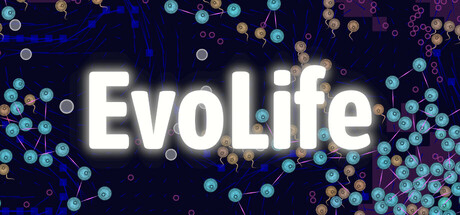
EvoLife simulates individual cells and their organelles in a physics-based ecosystem.
Cells begin with random DNA, and most fail to survive. Viable organisms can process gas bubbles, consume dead cells, grow flagella, swim against currents, release biomaterials, and remain attached after dividing. Environmental conditions shape which forms succeed, without predefined multicellular cell types. The simulation follows developments from simple cells through competition, physical barriers, stromatolite-like structures, and early multicellularity. Steam Workshop support provides saved worlds and sequences of saves that can advance evolutionary time by weeks through the in-game savefile list. The simulation runs on the video card and can handle hundreds of thousands of cells, depending on hardware.
How EvoLife plays
- 01Physics-based ecosystem
- Water flow, gas bubbles, rocks, dead cells, and other environmental conditions affect how organisms survive and develop.
- 02Organelles and DNA
- Each cell can grow different organelles and use DNA instructions that support functions such as energy processing and reproduction.
- 03Emergent multicellularity
- Cells may stay connected after division when individual flagella cannot provide enough support in strong currents.
- 04Workshop evolution sequences
- Downloaded save sequences can move a simulated world forward by weeks through the in-game savefile list.
- 05GPU simulation
- The simulation runs on the graphics card and is intended to support worlds containing hundreds of thousands of cells.
Games like EvoLife
Simulation Simulation
Thrive
Revolutionary Games StudioFor:Players interested in biology who want to experiment with cell structures and evolutionary strategiesSkip if:Players seeking a complete game spanning all planned evolutionary stages, since the Microbe Stage is the only fully complete stage Simulation
soul Interface
soulless technologiesFor:Players who want to design organisms at the level of individual atomsSkip if:Players seeking a tightly scripted experience may hit a wall when the game shifts to open-ended organism design and ecosystem management. Simulation
Species: Artificial Life, Real Evolution
QuasarFor:Players interested in natural selection who want to observe populations change without directing them.Skip if:Players seeking a goal-driven campaign may find the open-ended simulation lacks a stated sequence of objectives.Picked by overlapping fit notes and genres, not an editorial comparison.
EvoLife: platforms & release
Is EvoLife worth it?
It is worth it if: simulation players interested in how single-celled organisms could develop cooperative multicellular forms. Skip it if: players seeking direct control over individual creatures may find the simulation primarily observational and systems-driven.
Where can I download EvoLife?
Use the Download Now button on this page: it opens EvoLife's store page, where you can choose how to get it.
What platforms is EvoLife on?
Windows only.