Fit check
Is SGS Fall Weiss worth it for you?
We tell you who should skip it, too.
Play it if you…
Good fit- World War II history fans who want an operational campaign about the 1939 Polish invasion
- Turn-based strategy players who enjoy managing formations, terrain, reinforcements, and replacements
- Wargamers who want both historical and hypothetical scenarios with player-versus-player or AI play
Skip it if you…
Saves you a refund- Players seeking short, highly tactical engagements may lose interest in the 19-turn campaign and its operational unit scale
- Players who want a forgiving German campaign may hit a wall when managing speed, losses, supplies, and Polish defensive positions
- Players looking for real-time combat rather than turn-based planning will not find that pacing here
- Players seeking a broad collection of unrelated historical campaigns may find the main focus narrow because it centers on Poland in 1939
Our take on SGS Fall Weiss
The bounce point arrives when the German advance must balance speed against losses, supply problems, and Polish counter-attacks. Players choosing Poland face a steeper challenge while managing reinforcements, replacements, defensive terrain, and the Soviet invasion from the east.
What is SGS Fall Weiss?
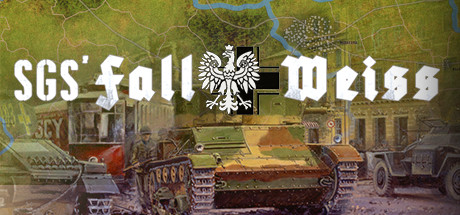
Play a turn-based operational wargame about the German campaign in Poland from September to October 1939.
A full campaign lasts 19 turns, with each turn representing two days, and uses division-, brigade-, regiment-, and some battalion-level units. Manage armour, motorised troops, cavalry, infantry, artillery, aircraft, armoured trains, and Polish river flotillas. Terrain, air support, replacements, reinforcements, supplies, and event cards affect operations. The campaign includes German, Polish, Slovakian, and Soviet forces, with victory tied to strategic objectives and the defender’s ability to hold out. Choose between historical and alternative campaign variants, play against another player by email or against the AI, and receive additional scenarios and other content automatically over time.
How SGS Fall Weiss plays
- 01Two Campaign Variants
- Historical and hypothetical versions alter available options, events, mobilisation, modernisation, and the possibility of Soviet intervention.
- 02Operational Unit Scale
- Forces are represented mainly by divisions, brigades, and regiments, with a smaller number of battalion-level counters.
- 03Combined Arms Battles
- Attacks require coordination between aircraft, armoured formations, artillery, and conventional infantry while accounting for terrain.
- 04Event Card System
- Cards introduce military, political, diplomatic, and economic situations that can change campaign conditions.
- 05Player And AI Games
- The campaign supports player-versus-player play by email as well as matches against artificial intelligence.
SGS Fall Weiss compared to similar games
Men of War: Assault Squad also covers World War II, but focuses on large-scale strategy combined with direct, hands-on combat and control of individual units. SGS Fall Weiss instead models the 1939 Polish campaign through turn-based, operational-scale formations, event cards, terrain, replacements, and alternative campaign conditions. Xenonauts centers on defending Earth from an alien invasion with small squads of persistent soldiers, rather than commanding historical armies across a 19-turn campaign.
SGS Fall Weiss: platforms & release
Is SGS Fall Weiss worth it?
It is worth it if: world War II history fans who want an operational campaign about the 1939 Polish invasion. Skip it if: players seeking short, highly tactical engagements may lose interest in the 19-turn campaign and its operational unit scale.
Where can I download SGS Fall Weiss?
Use the Download Now button on this page: it opens SGS Fall Weiss's store page, where you can choose how to get it.
What platforms is SGS Fall Weiss on?
Windows and macOS.