Fit check
Is Habitat worth it for you?
We tell you who should skip it, too.
Play it if you…
Good fit- Players who want physics-driven spacecraft construction rather than conventional ship control
- Strategy fans who enjoy scavenging debris and converting structures into weapons
- Creative builders who prefer open-ended experimentation in a sandbox mode
Skip it if you…
Saves you a refund- Players seeking tightly controlled movement may hit a wall when weight, thrust, and zero gravity govern station handling.
- Players wanting a compact, repeatable combat loop may find the building, scavenging, exploration, and crisis systems too involved.
- Players looking for a conventional terrestrial survival game may not want its space-station setting and improvised construction focus.
Our take on Habitat
The bounce point arrives at the flight model: players must account for weight, thrust, and zero gravity while piloting structures assembled from debris. Those expecting direct, conventional vehicle controls may struggle before the campaign’s combat and rescue objectives become the focus.
What is Habitat?
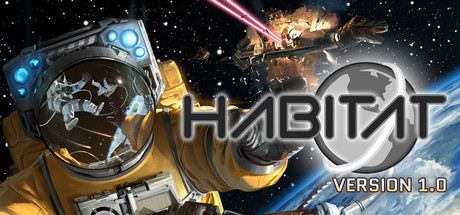
Habitat is a physics-based space game about constructing, piloting, and fighting with improvised stations assembled from orbital debris.
Players can combine habitats into a larger structure or operate a fleet, then use weight, thrust, and zero gravity to control movement. Procedurally generated regions around Earth, the Moon, and Mars provide space to explore and scavenge. Campaign missions follow engineers and citizens seeking safety while facing rival factions, space zombies, fires, ice storms, electrical bursts, and EMP events. Sandbox mode provides an open setting for building and experimentation. Hundreds of construction pieces, including rockets, lasers, particle accelerators, and unusual junk, can be used to customize stations and turn them into weapons.
How Habitat plays
- 01Physics-based flight
- Station movement depends on factors including weight, thrust, and zero gravity.
- 02Campaign missions
- A narrative campaign follows engineers and civilians during efforts to reach safety.
- 03Creative sandbox
- A separate mode provides an open space for construction and experimentation.
- 04Procedural space
- Exploration areas are generated around Earth, the Moon, and Mars.
- 05Improvised weaponry
- Scavenged items such as rockets, lasers, and particle accelerators can be fitted to habitats for combat.
- 06Environmental crises
- Fire, ice storms, electrical bursts, and EMP events create hazards during play.
Habitat compared to similar games
Habitat combines station construction, physics-based flight, scavenging, and combat across campaign and sandbox modes. Until We Die centers on defending an underground subway base for about 30 game days, while Creeper World 4 focuses on real-time base building, resource production, and fighting fluid-like enemy waves across 3D terrain.
Habitat: platforms & release
Is Habitat worth it?
It is worth it if: players who want physics-driven spacecraft construction rather than conventional ship control. Skip it if: players seeking tightly controlled movement may hit a wall when weight, thrust, and zero gravity govern station handling.
Where can I download Habitat?
Use the Download Now button on this page: it opens Habitat's store page, where you can choose how to get it.
What platforms is Habitat on?
Windows, macOS and Linux.