Fit check
Is Serpent in the Staglands worth it for you?
We tell you who should skip it, too.
Play it if you…
Good fit- CRPG players who want party tactics and non-linear exploration
- Tabletop-inspired RPG fans who prefer solving leads without automatic markers
- Players who enjoy experimenting with skill combinations across multiple characters
Skip it if you…
Saves you a refund- Players seeking a guided campaign with checklist quests, automatic map markers, or rigid story exposition
- Players who prefer cooldown-driven combat or a fixed class system over pausing, positioning, and custom builds
- Players looking for a straightforward hero story about saving the world
Our take on Serpent in the Staglands
The game gives up guided quest navigation and conventional hero framing in favor of player-led investigation. Hand-drawn maps, personal notes, and an unmarked world make the journey less directed, while the weakened-god premise replaces a standard good-versus-evil campaign.
What is Serpent in the Staglands?
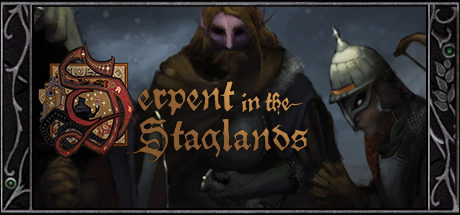
Serpent in the Staglands is a party-based CRPG set in an icy peninsula within the late-Bronze-Age-inspired world of Vol.
Players role-play Necholai, a minor god trapped in mortal form, while investigating a harsh land shaped by politics, races, and gods. Exploration uses hand-drawn maps, an in-game journal, foreign-language diagrams, and unsignposted locations rather than checklist quests or automatic map markers. Combat runs in real time with pauses, emphasizing positioning, pre-buffing, and party combinations without cooldowns. A classless system offers over 100 magic, combat, and aptitude skills for creating or finding up to five characters. The story is non-linear, and the map has no level scaling or story-blocked barriers.
How Serpent in the Staglands plays
- 01Classless character building
- More than 100 magic, combat, and aptitude skills can be combined across up to five characters.
- 02Tactical pause combat
- Encounters focus on positioning, pre-buffing, and automatically triggered skills instead of cooldowns.
- 03Unmarked exploration
- The map includes wilderness, cities, towers, temples, dungeons, and caverns without automatic location markers.
- 04Player-written journal
- Notes can be recorded for quests, puzzles, and leads during investigations.
- 05Contextual tool use
- Specialized tools for spellwork, navigation, and potion-making serve different needs during travel and preparation.
- 06Windows Mac Linux demo
- A demo is available for Windows, Mac, and Linux.
Serpent in the Staglands compared to similar games
Planescape: Torment: Enhanced Edition centers on an unconventional story and exploration of a strange, dangerous city, while Serpent in the Staglands uses party combat, custom skill combinations, and an unmarked wilderness. Back to the Dawn is a prison-escape RPG focused on survival, investigation, and breaking out of a maximum-security facility; Serpent in the Staglands instead follows a trapped god through a non-linear fantasy peninsula. Ghost of a Tale combines action-RPG play with stealth, disguises, and conversations, whereas Serpent in the Staglands emphasizes real-time-with-pause party tactics and classless character building.
Serpent in the Staglands: platforms & release
Is Serpent in the Staglands worth it?
It is worth it if: CRPG players who want party tactics and non-linear exploration. Skip it if: players seeking a guided campaign with checklist quests, automatic map markers, or rigid story exposition.
Where can I download Serpent in the Staglands?
Use the Download Now button on this page: it opens Serpent in the Staglands's store page, where you can choose how to get it.
What platforms is Serpent in the Staglands on?
Windows, macOS and Linux.